Glossary
Investing Glossary for Beginners (2026)
Every hobby has its jargon, and investing has more than most. Here are the 32 terms you will meet first, each explained in plain English - no finance degree required.
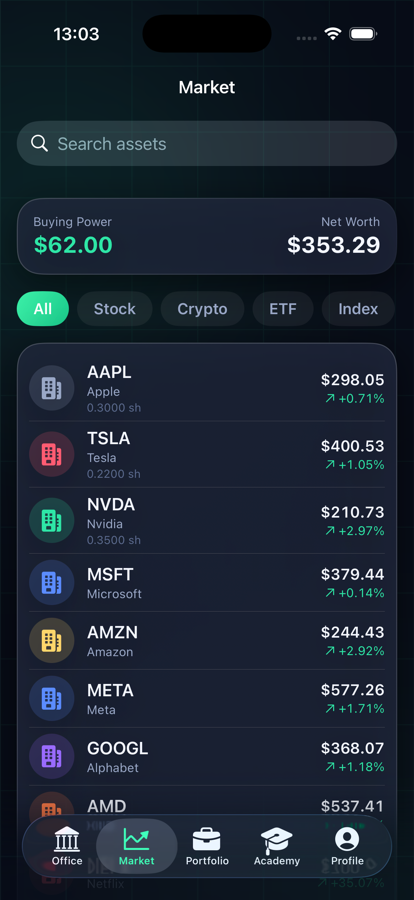
You do not need to memorise all of these at once. Skim them, come back when a word trips you up, and - most usefully - practise each one with virtual cash so the meaning sticks. The fastest way to understand "volatility" or "diversification" is to own something and watch it move. Terms in bold below link to their own deep-dive guide.
The 32 terms, A to Z
Asset allocation
How you split your money across different asset types - such as stocks, bonds, cash and crypto. It is the single biggest driver of how risky your portfolio is, far more than any individual pick.
Bear market
A prolonged period when prices fall broadly, usually defined as a drop of 20% or more from recent highs. Investors feel pessimistic - but bear markets are also when patient buyers find bargains.
Bid/ask
The bid is the highest price a buyer will pay right now; the ask is the lowest price a seller will accept. The small gap between them is the "spread", and it is effectively a hidden cost of trading.
Bitcoin
The first and largest cryptocurrency: a digital asset with a capped supply of 21 million coins. It is highly volatile, trades 24/7, and has no company or earnings behind it - price is driven by supply, demand and sentiment.
Blue chip
A large, well-established, financially strong company with a long track record - the household names of the market. Blue chips are generally steadier and slower-growing than young companies.
Bond
A loan you make to a government or company in return for regular interest and your money back at a set date. Bonds are generally lower risk than stocks and are often used to steady a portfolio.
Broker
The app or company that lets you buy and sell investments. It routes your orders to the market and holds your assets for you. Most modern brokers charge little or nothing to trade.
Bull market
A prolonged period when prices rise broadly and investor confidence is high - the opposite of a bear market. Bull markets can last for years, but no bull market lasts forever.
Capital gain
The profit you make when you sell an investment for more than you paid for it. Sell for less and you have a "capital loss". Gains are only locked in once you actually sell.
Commodity
A raw physical good that is traded on markets, such as gold, oil, silver or wheat. Prices move with global supply and demand. In Investor Arena you can trade gold and oil alongside stocks.
Compounding
When your returns start earning their own returns, so growth speeds up over time. It is the quiet force that rewards starting early and staying invested. Read the full guide to compounding →
Crypto (cryptocurrency)
A digital asset such as Bitcoin or Ethereum that runs on a blockchain rather than a bank. It is the most volatile asset most beginners meet, so it is best held as a small slice of a diversified portfolio.
Diversification
Spreading your money across many investments so no single loss can sink you. It lowers risk without necessarily lowering long-term returns - the closest thing investing has to a free lunch. Read the full guide to diversification →
Dividend
A share of a company's profit paid out to shareholders, usually as cash a few times a year. Not every company pays one - many young, fast-growing firms reinvest instead. Read the full guide to dividends →
Dollar-cost averaging
Investing a fixed amount on a regular schedule regardless of price. It removes the stress of timing the market and smooths out your average buy price over time. Read the full guide to dollar-cost averaging →
ETF
An exchange-traded fund: a single ticker that holds a basket of many investments, giving instant diversification, usually at very low cost. The most beginner-friendly way to own the market. Read the full guide to ETFs →
Forex
The foreign exchange market, where currencies such as the dollar, euro and yen are traded against each other. It is the largest and most liquid market in the world, open around the clock.
Index fund
A fund that simply tracks a whole market index, such as the S&P 500, instead of trying to beat it. Low cost and broadly diversified, index funds are a classic beginner core holding - often bought as an ETF.
IPO
An initial public offering: the first time a private company sells shares to the public and becomes listed on a stock exchange. IPOs can be exciting but are often extra volatile early on.
Liquidity
How quickly and easily you can buy or sell an asset without moving its price. Cash and big stocks are very liquid; a rare collectible or tiny stock is not. High liquidity usually means tighter spreads.
Market cap
The total value of a company's shares - share price multiplied by the number of shares. It tells you how big a company really is: large, mid or small cap. Read the full guide to market cap →
Mutual fund
A professionally managed pool of money from many investors, invested in a mix of assets. Similar to an ETF, but usually priced just once a day and sometimes with higher fees.
Net worth
Everything you own minus everything you owe. Growing your net worth steadily over time is the real scoreboard of investing - and the metric Investor Arena tracks as you play.
Paper trading
Practising investing with fake money against real market prices. You learn how markets behave, test a strategy, and build confidence without risking a cent. It is exactly what Investor Arena is built for.
Portfolio
The full collection of investments you own - your stocks, ETFs, crypto, bonds and cash taken together. A healthy portfolio is diversified rather than concentrated in one bet.
Risk
The chance that an investment loses value or does not perform as hoped. Higher potential returns almost always come with higher risk - the skill of investing is taking risk you can actually live with.
ROI
Return on investment: how much you gained or lost relative to what you put in, shown as a percentage. Put in $100, end with $110, and your ROI is 10%. A simple way to compare very different investments.
Stock
A security representing ownership in a company. If the business grows, your stock can rise; if it struggles, your stock can fall. A single stock carries concentrated risk, which is why diversification matters.
Ticker
The short code that identifies a stock or fund on an exchange, such as AAPL for Apple or SPY for an S&P 500 ETF. Tickers are how you search for and place trades.
Volatility
How much and how fast a price swings up and down. High volatility means bigger, quicker moves - and usually more risk. Crypto is very volatile; a broad ETF is far calmer.
Practise every term with $100 virtual cash and live prices.
Get Investor Arena Free
Educational game & simulator. Not financial advice.
Go deeper: beginner guides
Ready to move past definitions? These plain-English guides walk you through the ideas that matter most:
- What is an ETF? · What is compounding? · What is diversification?
- What is a dividend? · What is dollar-cost averaging? · What is market cap?
- Stocks vs ETFs vs crypto · How to start investing with $100 · Learn the stock market without risking money
- Best stock market simulator apps (2026) · Paper trading vs real trading · How to learn investing with no money
Glossary FAQ
What is the difference between stocks and ETFs? A stock is a piece of one company, so its price rises and falls on that single business. An ETF is one ticker that holds many investments at once, so it spreads your money widely and is generally lower risk and more beginner-friendly.
What does diversification mean in investing? Diversification means spreading your money across many different investments so no single loss can sink your whole portfolio. When one asset falls, others can cushion the blow, which lowers your overall risk.
How can a beginner practise investing without risking money? Use a stock market simulator that gives you virtual cash to buy stocks, ETFs and crypto against real, live prices. You learn how each term behaves in a real market before putting a single real dollar at risk.