Term
What Is a Dividend?
Some companies pay you simply for holding their stock. That payment is a dividend - a slice of the profits, sent straight to shareholders.
The short answer
A dividend is a share of a company's profit paid out to its shareholders, usually as cash and typically a few times a year. If you own 10 shares of a company that pays a $1 dividend per share, you receive $10 - just for holding the stock. It is one of the two ways a stock can reward you; the other is the share price rising over time.
Why companies pay them
When a company makes more money than it needs to reinvest, it can hand some of that surplus back to the people who own it. Mature, stable businesses - think long-established blue chips - often pay steady, growing dividends because their growth days are calmer. Younger, faster-growing companies usually pay nothing and plough every dollar back into expansion instead. Neither approach is "better"; they simply suit different kinds of investors.
Understanding dividend yield
To compare dividends across stocks, investors use yield: the annual dividend divided by the share price, shown as a percentage. A stock paying $2 a year with a $50 price has a 4% yield. A very high yield can look tempting but sometimes signals a struggling company, so yield is a starting point for research, not a guarantee.
The power of reinvesting
Here is where dividends get interesting. Instead of spending the cash, you can reinvest it to buy more shares - which then pay their own dividends, which buy still more shares. That feedback loop is one of the clearest real-world examples of compounding, and over many years it can add up to a large share of an investor's total return. Pairing dividend reinvestment with a steady habit like dollar-cost averaging keeps the snowball rolling.
Dividends and diversification
You do not have to pick individual dividend stocks one by one. Many ETFs focus on dividend-paying companies and pass that income on to you, giving you a diversified stream of dividends in a single holding - a tidy way to get income and diversification together.
Practice it risk-free
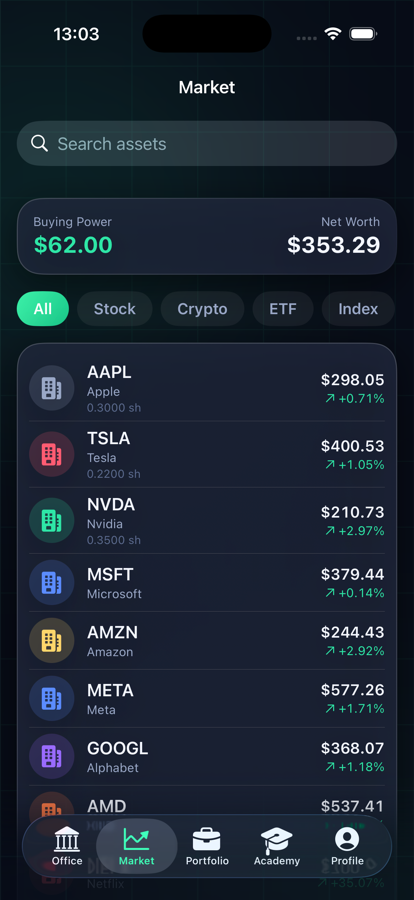
The best way to understand dividends is to hold dividend-paying companies and see how they behave. In Investor Arena you get $100 in virtual cash and live, real-world prices, so you can build an income-focused portfolio and watch it move - without risking a cent.
$100 virtual cash, live prices, zero real risk.
Get Investor Arena Free
Educational game & simulator. Not financial advice.
FAQ
Do all stocks pay dividends? No - many established companies pay them, but plenty of younger, fast-growing companies pay none and reinvest profits into growth instead.
What is dividend yield? The annual dividend divided by the share price, shown as a percentage. A $2 dividend on a $50 stock is a 4% yield.
Should I reinvest my dividends? Reinvesting buys more shares that pay their own dividends - a compounding loop. Taking the cash makes sense if you need the income now.
Related: Investing glossary · What is compounding? · What is an ETF? · Stocks vs ETFs vs crypto.