Guide
Stocks vs ETFs vs Crypto: A Beginner's Guide
Three words you hear constantly - here's what they actually mean, how risky each one is, and how to practice with all three before you risk a cent.
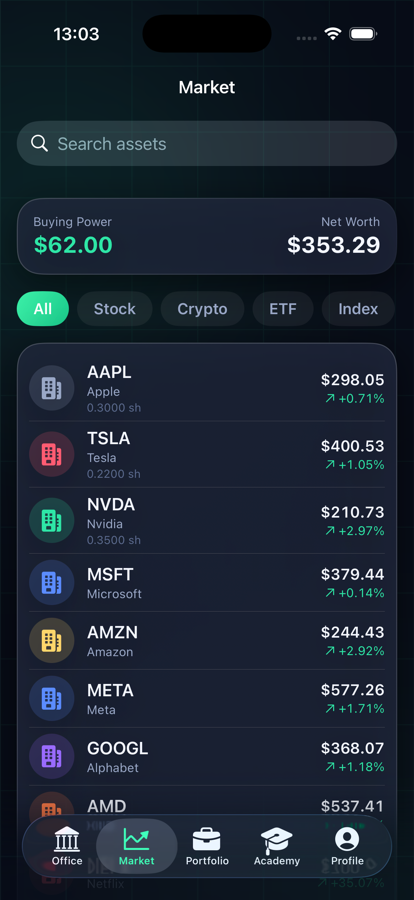
Stocks, ETFs and crypto are the three building blocks most beginners meet first. They sound interchangeable, but they behave very differently - one is a bet on a single company, one spreads your money automatically, and one can move faster than you can blink. Understand the trade-offs and you can build a mix that fits how much risk you can actually stomach.
Stocks
A stock is a slice of one company. Buy Apple and you own a tiny piece of Apple - if the business grows, so does your share; if it stumbles, your share falls with it. Upside: a great company can compound for years. Downside: a single company carries concentrated risk - a bad earnings report, a lawsuit, or a new competitor can wipe out gains fast. Owning individual stocks means doing homework: reading earnings, understanding the business, and accepting bigger swings.
Example: putting your whole $100 into one stock could double it - or cut it in half - on a single headline. That is the price of concentration.
ETFs
An ETF (exchange-traded fund) bundles many investments into one ticker. An S&P 500 ETF holds 500 of the largest US companies, so a single purchase spreads your money widely - instant diversification, lower risk, and far less homework. Fees are usually tiny (often under 0.1% a year). Because no single company can sink the whole fund, ETFs are the most beginner-friendly way to own the market, and they make an excellent core holding you can buy and hold for years.
Crypto
Crypto (Bitcoin, Ethereum and thousands of others) is the most volatile of the three - it trades 24/7 and can swing double digits in a single day. There are no earnings, no dividends, and prices are driven largely by supply, demand and sentiment. That volatility is exciting and occasionally very rewarding, but it is only sensible as a small slice of a diversified portfolio - money you can genuinely afford to see fall hard.
Quick comparison
| Type | Risk | Diversified? | Effort | Best for |
|---|---|---|---|---|
| ETF | Low-Med | Yes (built-in) | Low | Beginners, core holdings |
| Stock | Medium-High | No (one company) | Medium | Conviction picks |
| Crypto | High | No | Medium | Small high-risk slice |
The smart beginner mix
A common starting point is simple: a broad ETF as your base (the bulk of your money), one or two individual stocks you genuinely believe in, and a small crypto position for upside. A classic beginner split might be roughly 70% ETF, 20% stocks and 10% crypto - then you rebalance occasionally so no single position quietly takes over. The exact numbers matter less than the principle: keep the risky slices small, and let diversification do the heavy lifting.
The mistake to avoid is chasing whatever went up the most last week. Diversification feels boring precisely because it works - when one asset drops, the others cushion the blow, and you stay in the game long enough to compound.
How to practice all three risk-free
The fastest way to feel these differences is to own each one and watch it move - without risking real money. A stock market simulator lets you buy stocks, ETFs and crypto against real prices with virtual cash, so you learn how each behaves in a real market before a single dollar is on the line.
FAQ
Are ETFs safer than stocks? Generally yes - a broad ETF spreads risk across hundreds of companies, so no single failure can sink it. A single stock rises and falls on one business.
How much crypto should a beginner hold? A small slice - often 5-10% of a portfolio at most - and only money you can afford to lose, because swings are large.
Can I own all three at once? Yes. Most investors do exactly that: an ETF core, a few stocks, and a little crypto. You can practice that exact mix free in Investor Arena.
Play Investor Arena Free
Educational game & simulator. Not financial advice.
Related: How to start investing with $100 · Learn the stock market without risking money · Best stock market simulator apps (2026) · Paper trading vs real trading · Investing glossary.