Guide
Paper Trading vs Real Trading: What's the Difference?
They look almost identical on screen. What changes everything is whose money is at stake - and how that rewires your brain.
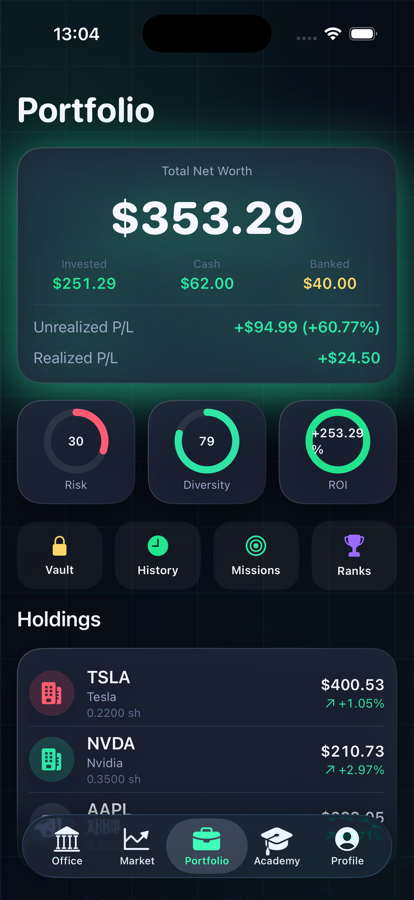
If you're new to investing, you've probably seen the term paper trading and wondered how it compares to the real thing. The short answer: the buttons are the same, but the stakes are not. Understanding the gap between the two is one of the most useful things a beginner can learn, because it tells you exactly what practice can and can't prepare you for.
What is paper trading?
Paper trading - also called practice trading or simulated trading - means placing trades with virtual money against real market prices. You pick assets, buy and sell, and watch your virtual portfolio rise and fall exactly as it would in the real market. Nothing real is gained or lost. The name comes from the old habit of tracking hypothetical trades on paper before the internet made it instant.
What is real trading?
Real trading means buying and selling actual assets through a licensed broker with your own money. Gains are really yours; losses are really gone. It involves a funded brokerage account, real order execution, fees or spreads, and tax consequences - none of which a simulator has to worry about.
The key differences
| Paper trading | Real trading | |
|---|---|---|
| Money at risk | None (virtual) | Your own capital |
| Prices | Real market data | Real market data |
| Emotional pressure | Low | High |
| Cost of mistakes | Zero | Real losses |
| Best for | Learning & testing | Building real wealth |
The psychology gap
Here's the honest part most guides skip: the biggest difference isn't the mechanics, it's the emotion. When it's virtual money, holding through a 20% dip is easy. When it's your rent, fear and greed get loud - and that's when people panic-sell at the bottom or chase a stock at the top. Paper trading can't fully replicate that pressure, so treat a flawless practice run with humility. What it can do is make the mechanics second nature and drill in good habits, so when real emotions arrive you're not also fumbling with how to place an order.
How to get the most from practice trading
- Trade like it's real. Diversify, size positions sensibly, and follow a plan - don't go all-in on one meme stock just because it's fake money.
- Practice the hard skill: holding. Deliberately sit through a dip without selling. That single habit saves real investors the most money.
- Learn the concepts alongside the trades. Knowing why an ETF is less risky than a single stock matters more than any one trade.
- Keep it consistent. Investing rewards showing up regularly, so build the routine now while it's free.
A fun, free way to practice
Investor Arena is a free iPhone game built for exactly this transition. You start with $100 of virtual cash and trade real-world stocks, ETFs, gold, oil and crypto at live prices. Illustrated Academy lessons and Quiz Battles teach the concepts, ranks and streaks keep you consistent, and every mistake costs you nothing but a lesson. It's the flight simulator you use before you fly with real money.
Get Investor Arena on the App Store
Educational game & simulator. Not a brokerage. Not financial advice. All cash and portfolios are virtual in-game items.
Related: Best stock market simulator apps (2026) · Learn the stock market without risking money · How to learn investing with no money · Investing glossary.