Guide
Best Stock Market Simulator Apps to Learn Investing (2026)
A good simulator is the safest, fastest way to learn how markets really move. Here's what separates a great one from a forgettable one - and our honest pick for beginners.
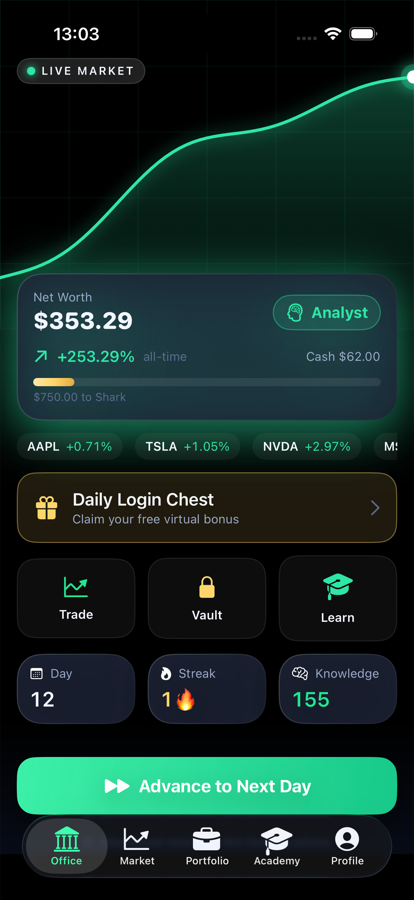
Reading about investing only takes you so far. You remember what you do, not what you skim. That's why a stock market simulator - an app that lets you trade with virtual money at real prices - is the single best on-ramp for a new investor. The problem is that not all simulators are built the same. Some feel like spreadsheets, some use stale prices, and some are secretly designed to funnel you into risky real-money trading. Here's how to choose well.
What to look for in a stock market simulator
- Real, live prices. A simulator is only useful if its prices track the real market. Practice on live data for stocks, ETFs, gold, oil and crypto so the ups and downs you feel are genuine.
- Truly free to practice. You should never have to pay to learn. Look for a generous starting balance and no paywall on the core experience.
- Real variety of assets. Great simulators let you hold more than a couple of tech stocks - individual shares, diversified ETFs, commodities and crypto - so you learn how different asset classes behave.
- Built-in learning. The best apps teach as you go with short lessons and quizzes, instead of dropping you into a blank trading screen.
- Motivation to keep showing up. Investing rewards consistency. Streaks, ranks, missions and leaderboards turn a dry habit into something you actually return to daily.
- Honest framing. A responsible simulator is clear that it is educational, uses virtual money, and is not financial advice or a brokerage.
Our pick for beginners: Investor Arena
If you want a simulator that is genuinely built for learning - not a stripped-down brokerage demo - Investor Arena is our top pick for beginners in 2026. You start with $100 of virtual cash and trade real-world stocks, ETFs, gold, oil and crypto at live prices, completely risk-free.
What makes it stand out is that the learning is baked in. An illustrated Academy teaches diversification, risk and compounding in small, digestible lessons, and Quiz Battles turn those ideas into points. As you trade and learn you climb from Rookie to Legend, keep daily streaks alive, complete missions, and compete in a weekly tournament with Game Center leaderboards. It feels like a game because it is one - and that is exactly what keeps beginners coming back long enough to build real intuition.
How the categories compare
Broadly, simulator apps fall into three buckets. Brokerage demo accounts mirror a real trading platform but assume you already know what you're doing. Classroom simulators are aimed at students and contests, often with delayed data. Learn-first game simulators like Investor Arena focus on teaching habits with live prices and progression. If you're brand new, the learn-first category is usually the friendliest place to start; you can always graduate to a demo account later.
A quick reality check
No simulator can predict the market or guarantee results, and practicing is not the same as risking real capital - the emotions hit differently when it's your own money. But that's the point of practicing first: you make your rookie mistakes for free. Learn to diversify, to size positions sensibly, and above all to not panic sell, and you'll carry those habits into the real thing.
Get Investor Arena on the App Store
Educational game & simulator. Not a brokerage. Not financial advice. All cash and portfolios are virtual in-game items.
Related: Paper trading vs real trading · How to learn investing with no money · Learn the stock market without risking money · Investing glossary.