Term
What Is Dollar-Cost Averaging?
Nobody can reliably guess the market's next move. Dollar-cost averaging is the simple habit that lets you stop trying - and invest calmly anyway.
The short answer
Dollar-cost averaging (DCA) means investing a fixed amount of money on a regular schedule - for example, $50 every month - no matter what the price is that day. You do not try to buy at the "perfect" moment. You just keep buying steadily, and over time your purchase prices average out.
Why it works
Because you spend the same amount each time, your money automatically buys more shares when prices are low and fewer when prices are high. That quietly pulls your average cost down and takes the emotion out of investing. You never have to predict a top or a bottom, which is a game almost nobody wins consistently.
A quick example
Say you invest $100 a month into one fund over four months while the price bounces around:
| Month | Price | $100 buys |
|---|---|---|
| 1 | $10 | 10 shares |
| 2 | $8 | 12.5 shares |
| 3 | $5 | 20 shares |
| 4 | $8 | 12.5 shares |
You invested $400 and now own 55 shares, for an average cost of about $7.27 per share - lower than the simple average price of $7.75, because your fixed budget scooped up extra shares when things were cheap. That is the DCA effect in miniature.
The real benefit is behavioural
DCA's greatest strength is that it keeps you consistent. Fear makes people freeze when markets fall and pile in when markets are euphoric - exactly backwards. A fixed schedule removes those decisions entirely, so you keep feeding your investments through good times and bad. That steady contribution is also what fuels compounding over the long run.
What it does not do
Dollar-cost averaging lowers timing risk, but it does not remove risk altogether - the value of your holdings can still fall. It works best when paired with diversification, for example by drip-feeding into a broad ETF rather than a single volatile stock.
Practice it risk-free
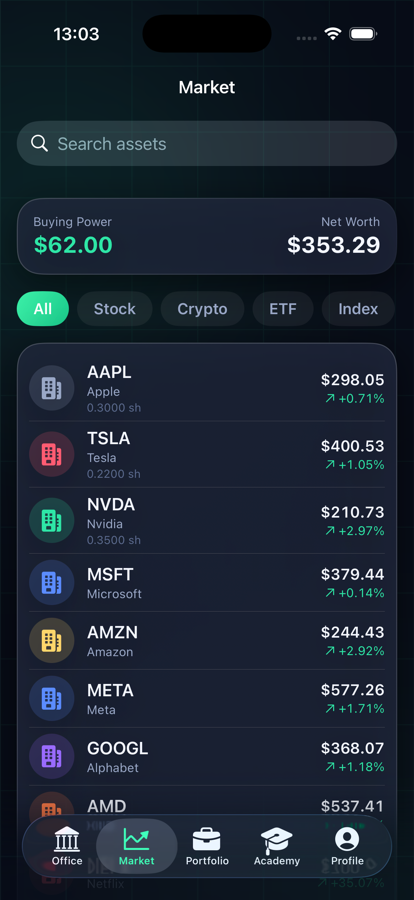
DCA is a habit, and habits are best rehearsed. In Investor Arena you get $100 in virtual cash and live, real-world prices, so you can practise adding to a position over time and watch how a steady approach behaves versus one big all-in bet - without risking a cent.
$100 virtual cash, live prices, zero real risk.
Get Investor Arena Free
Educational game & simulator. Not financial advice. Figures shown are illustrative examples.
FAQ
How does dollar-cost averaging work? You invest the same fixed amount on a regular schedule regardless of price, so low prices buy more shares and high prices buy fewer - smoothing your average cost.
Is it better than investing all at once? Its biggest benefit is behavioural - it removes timing stress and keeps you consistent. Lump-sum investing has sometimes done better historically, but DCA is easier to stick with.
Does it remove all risk? No. It reduces timing risk, but your investments can still fall in value. It works best combined with diversification.
Related: Investing glossary · What is compounding? · What is diversification? · How to start investing with $100.