Term
What Is an ETF?
One ticker, hundreds of companies. The ETF is the single most beginner-friendly way to own the market - here is exactly how it works.
The short answer
An ETF - short for exchange-traded fund - is a single investment that holds a basket of many other investments inside it. When you buy one share of an S&P 500 ETF, you are buying a tiny slice of 500 of the largest companies in the United States at once. It trades on an exchange just like a normal stock, so you can buy and sell it any time the market is open, at a price that moves through the day.
Why ETFs matter for beginners
The biggest reason is instant diversification. Instead of trying to pick the one winning company, you own hundreds in a single click, so no single business can sink you. If one company in the fund has a terrible year, the other 499 cushion the blow. That is why an ETF is far less risky than betting your whole balance on one stock - and why it makes such a strong core holding you can buy and simply hold for years.
The second reason is cost. Broad index ETFs are famously cheap: many charge an "expense ratio" under 0.1% a year, which is less than a dollar a year on every $1,000 invested. Low fees mean more of your return stays in your pocket, and over decades that difference compounds into real money.
How an ETF actually works
Behind the scenes, a fund provider builds a basket of assets - say, every company in a well-known index - and then issues shares in that basket. Those shares are what you buy and sell. The ETF's price roughly tracks the combined value of everything it holds. Some ETFs follow a whole stock market, some follow a single country or sector, and others track commodities like gold. For a beginner, a broad, low-cost, whole-market ETF is usually the simplest and safest place to start.
ETF vs individual stock
A single stock is a bet on one company: bigger swings, more homework, higher risk. An ETF spreads that bet automatically. Many investors use both - an ETF as the calm core of their portfolio, and a few individual stocks for conviction picks. If you are just starting, leaning heavily on ETFs keeps your risk sensible while you learn.
Practice it risk-free
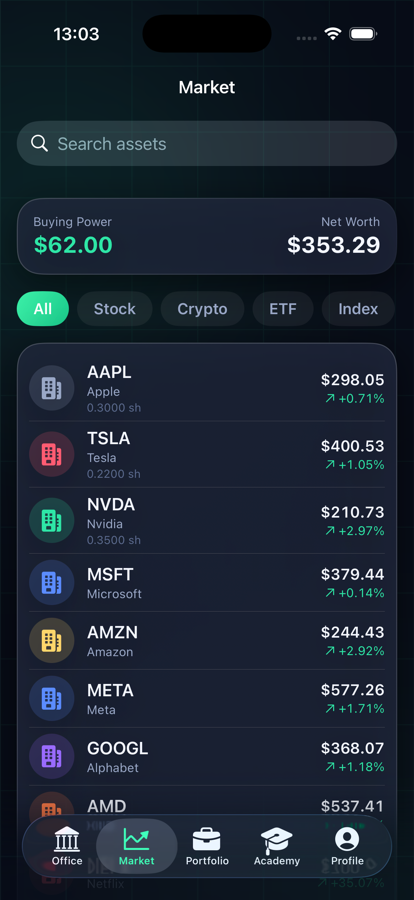
The fastest way to understand an ETF is to own one and watch it move against a single stock. In Investor Arena you get $100 in virtual cash and live, real-world prices, so you can buy an ETF, buy a single stock, and see the difference in volatility for yourself - without risking a cent.
$100 virtual cash, live prices, zero real risk.
Get Investor Arena Free
Educational game & simulator. Not financial advice.
FAQ
Is an ETF safer than a single stock? Generally yes - a broad ETF spreads your money across hundreds of companies, so no single failure can sink it. A single stock rises and falls on one business.
How much does an ETF cost? Broad index ETFs are cheap - many charge under 0.1% a year, less than $1 per year per $1,000 invested. You may also pay a small bid-ask spread when trading.
Can a beginner just buy one ETF? Yes. A single broad-market ETF already holds hundreds of companies, so it is a diversified starting point on its own.
Related: Investing glossary · What is diversification? · What is market cap? · Stocks vs ETFs vs crypto.