Term
What Is Market Cap?
A stock's price alone tells you almost nothing about how big the company is. Market cap is the number that actually does.
The short answer
Market cap - short for market capitalization - is the total value of a company's shares. You calculate it by multiplying the share price by the number of shares that exist:
Market cap = share price × shares outstanding
A company with 10 million shares priced at $50 each has a market cap of $500 million. It is the market's best single-number estimate of how much the whole business is worth.
Why price alone is misleading
Beginners often assume a $500 stock is "bigger" or "more expensive" than a $20 stock. Not so. A $500 stock with only a million shares is worth $500 million; a $20 stock with five billion shares is worth $100 billion. The price of a single share is arbitrary - companies can split their shares or issue more at any time. Only market cap tells you the real size of the business, which is why it matters far more than the sticker price.
The size categories
Investors group companies by market cap because size tends to shape behaviour:
| Category | Rough size | Character |
|---|---|---|
| Large cap | $10B and up | Established, steadier, lower volatility |
| Mid cap | $2B - $10B | Growing, balance of risk and reward |
| Small cap | Under $2B | Higher growth potential, higher risk |
The dollar boundaries are approximate and shift over time, but the pattern holds: the biggest companies - often blue chips - move more slowly and calmly, while the smallest can grow fast but swing hard.
How to use market cap
Market cap helps you judge risk and build a balanced mix. Large caps often form the stable core of a portfolio, while a smaller slice of mid or small caps adds growth potential. It is also how index funds decide their weightings: a big ETF usually holds more of the largest companies and less of the smallest, so market cap quietly shapes what you own even when you buy a single fund. Blending sizes is one more layer of diversification.
Practice it risk-free
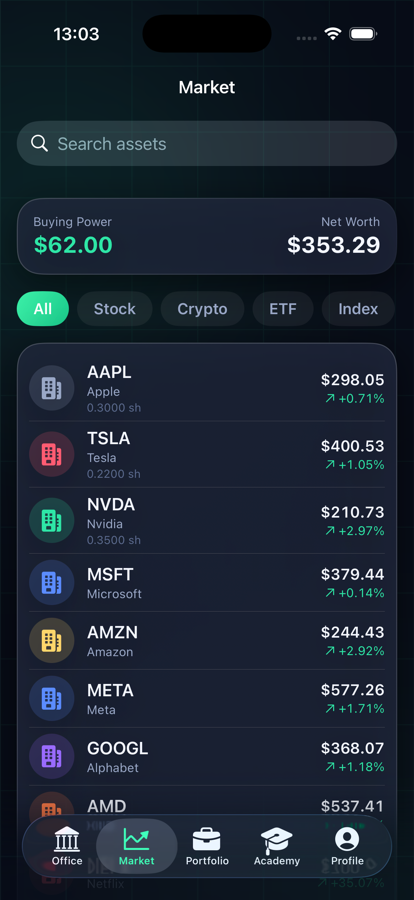
Reading definitions is one thing; feeling how a giant behaves next to a tiny company is another. In Investor Arena you get $100 in virtual cash and live, real-world prices, so you can hold companies of very different sizes and watch how their volatility differs - without risking a cent.
$100 virtual cash, live prices, zero real risk.
Get Investor Arena Free
Educational game & simulator. Not financial advice.
FAQ
How do you calculate market cap? Multiply the share price by the total number of shares outstanding. Ten million shares at $50 each equals a $500 million market cap.
Does a high share price mean a big company? No. A $500 stock with few shares can be worth less than a $20 stock with billions of shares. Only market cap reveals true size.
Are large caps safer than small caps? Generally yes - large caps are steadier and less volatile, while small caps can grow faster but swing more and carry higher risk.
Related: Investing glossary · What is an ETF? · What is diversification? · Stocks vs ETFs vs crypto.