Term
What Is Diversification?
"Don't put all your eggs in one basket." Diversification is that old proverb turned into a strategy - and it is the closest thing investing has to a free lunch.
The short answer
Diversification means spreading your money across many different investments so that no single loss can sink you. Instead of betting everything on one company, you own a mix - many companies, different industries, and often different asset types like stocks, bonds and commodities. When one investment falls, the others can hold steady or rise, so your overall portfolio takes a much smaller hit.
Why it works
The magic is that different investments do not all move together. A bad earnings report can crush a single stock, but it barely dents a basket of hundreds. By combining assets that respond differently to the same news, you smooth out the ride: fewer gut-wrenching drops, steadier growth, and far less chance of a single event wiping out your progress. Crucially, diversification can lower your risk without lowering your expected long-term return - which is why economists call it a rare free lunch.
What under-diversification looks like
Picture putting your whole $100 into one hot stock. If it doubles, you look like a genius. If bad news hits, you can lose half your money on a single headline. That is concentrated risk, and it is the mistake that ends the most beginner journeys early. Diversification trades away the thrill of one huge win in exchange for staying in the game long enough for compounding to do its work.
How to diversify in practice
You can diversify along several dimensions at once:
- Across companies - owning many businesses instead of one.
- Across sectors - technology, healthcare, energy and more, so one struggling industry does not dominate.
- Across asset types - blending stocks, bonds, commodities and a small slice of crypto.
The easiest shortcut is an ETF or index fund. A single low-cost fund can hold hundreds of companies, giving you broad diversification in one click - which is exactly why ETFs make such a strong core for beginners.
Practice it risk-free
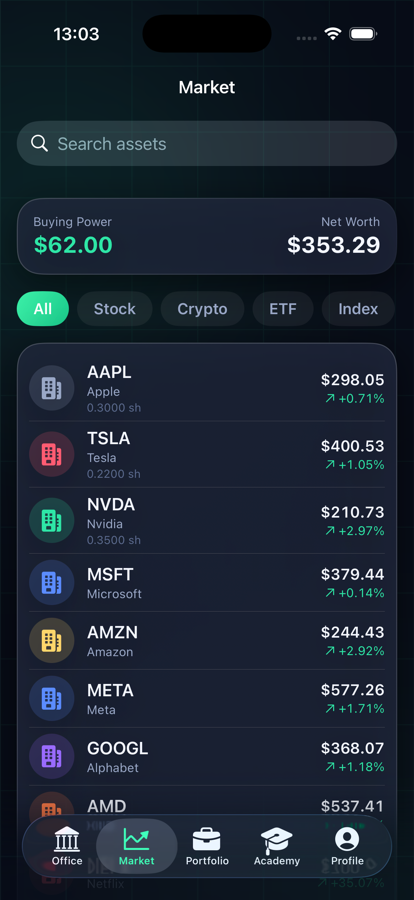
Diversification clicks once you feel it. In Investor Arena you get $100 in virtual cash and live, real-world prices, so you can build one concentrated bet and one spread-out portfolio side by side, then watch which one survives a rough day better - all without risking a cent.
$100 virtual cash, live prices, zero real risk.
Get Investor Arena Free
Educational game & simulator. Not financial advice.
FAQ
Why is diversification important? It protects you from the failure of any single investment - when your money is spread widely, one bad result is cushioned by the others.
What is the easiest way to diversify? Buy a broad ETF or index fund. A single share can hold hundreds of companies, giving instant diversification.
Can you be too diversified? You can spread so thin that no single winner matters, but for most beginners the bigger risk is being over-concentrated in one bet.
Related: Investing glossary · What is an ETF? · What is compounding? · Stocks vs ETFs vs crypto.