Term
What Is Compounding?
Albert Einstein supposedly called it the eighth wonder of the world. Whether he did or not, compounding is the quiet force that turns small, steady investing into real money.
The short answer
Compounding is when your returns start earning returns of their own. In the first year your money grows. In the second year, both your original money and last year's gains grow. Do that for long enough and the growth stops being a straight line and starts curving upward, because each year builds on a bigger base than the year before.
A simple example
Say you invest $100 and it grows 10% a year. Here is what happens if you leave it alone and let the gains stack:
| Year | Start of year | Growth (10%) | End of year |
|---|---|---|---|
| 1 | $100.00 | $10.00 | $110.00 |
| 2 | $110.00 | $11.00 | $121.00 |
| 5 | $146.41 | $14.64 | $161.05 |
| 10 | $235.79 | $23.58 | $259.37 |
Notice the growth in year 1 is just $10, but by year 10 a single year adds more than $23 - even though the rate never changed. That acceleration is compounding. The longer you stay invested, the more dramatic the curve becomes.
Why time beats timing
The most valuable ingredient in compounding is time, not luck. The earliest dollars you invest have the longest runway to snowball, which is why starting young - even with tiny amounts - can beat starting later with much more. It also means the costly mistake is not a bad year; it is sitting on the sidelines and giving your money less time to grow.
How to make compounding work for you
Three habits do most of the heavy lifting: invest regularly rather than waiting for the "perfect" moment, reinvest any dividends so they buy more shares, and avoid pulling your money out at the first wobble. A steady approach like dollar-cost averaging pairs beautifully with compounding, because it keeps feeding the snowball month after month.
See it for yourself, risk-free
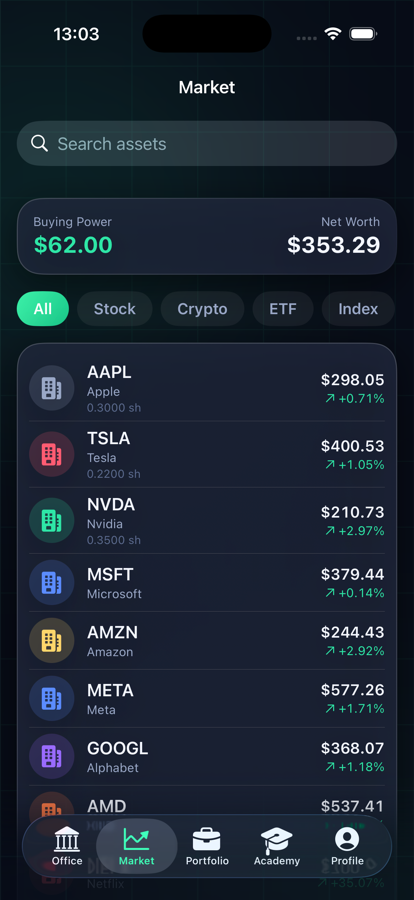
Compounding is easier to believe once you watch a balance climb. In Investor Arena you start with $100 in virtual cash and trade against live, real-world prices, so you can build a portfolio, hold it, and see how gains build on gains - without risking a cent.
$100 virtual cash, live prices, zero real risk.
Get Investor Arena Free
Educational game & simulator. Not financial advice. Figures shown are illustrative examples, not a forecast.
FAQ
What is compounding in simple terms? It is when the returns you earn start earning returns of their own, so your money grows on a steadily larger base and accelerates over time.
Why does starting early matter so much? Compounding needs time to build. The earliest money you invest has the longest to snowball, so small amounts invested young can outweigh larger amounts invested later.
Does compounding work with reinvested dividends? Yes - reinvested dividends buy more shares, which pay their own dividends, which buy still more shares. That loop is compounding in action.
Related: Investing glossary · What is a dividend? · What is dollar-cost averaging? · How to start investing with $100.